Strongest League in Europe: 2026/27 ELO Rankings
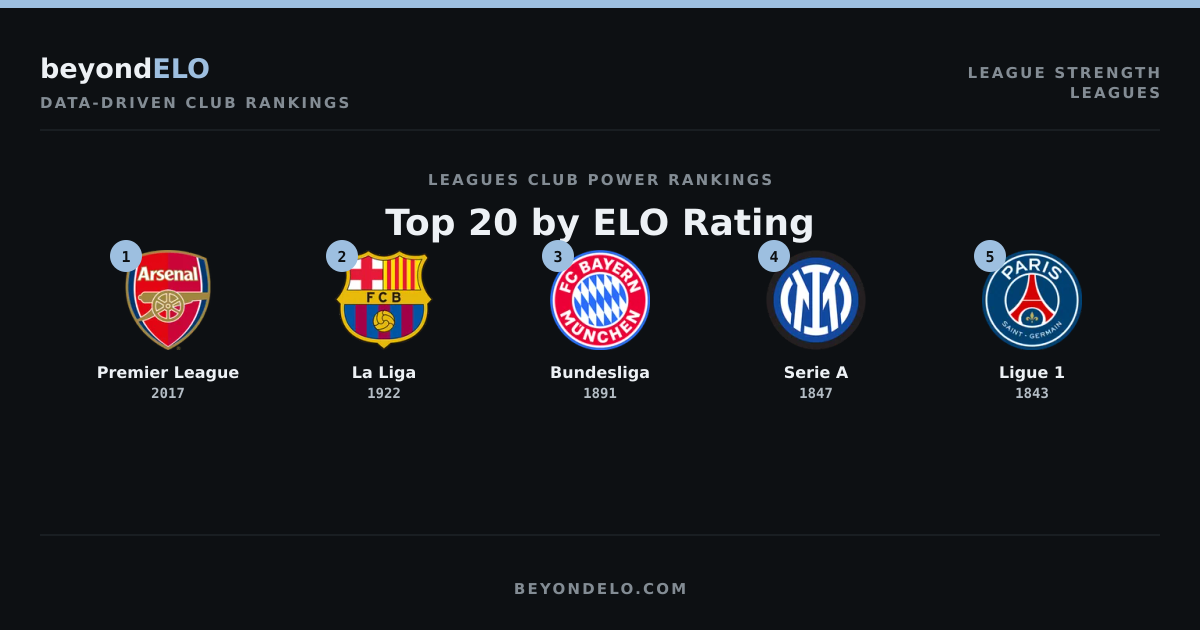
England's Premier League is the strongest league in Europe as of 2026-10-31, posting an elite top-five club average rating of 2017 points on the beyondELO scale.
The strongest league in Europe is the English Premier League, recording an average rating of 2017 points across its five highest-rated clubs as of 2026-10-31. It stands as the only competition on the continent whose top five clubs maintain an average rating exceeding the 2000-point threshold.
Evaluating the European club rankings by domestic depth demonstrates clear structural tiers across the continent. While traditional cup competitions or coefficients track match outcomes in isolated tournaments, an ELO-based approach tracks relative match difficulty across domestic leagues and continental play simultaneously.
Why England Leads the Strongest League in Europe Debate
England's top-five average of 2017 places it 95 rating points clear of second-placed Spain (1922). This gap represents the largest statistical drop between any two consecutive ranks in the European hierarchy.
At the peak of the England club rankings, Arsenal hold the European number one spot with a 2143 rating, gaining 16 rating points this season. What distinguishes the Premier League is not merely its flagship club, but the supporting pack: for a league's top five to average 2017 when its best club sits at 2143, the remaining four clubs must maintain an average of 1985.5. No other European competition features a second club rated near that mark besides Spain, Germany, and France.
The Elite Chasers: Top 5 Leagues in Europe
Behind England, the composition of the traditional top five leagues reveals differing distributions of strength between solitary powerhouses and collective depth:
- Spain (La Liga, 1922 average): Barcelona lead the Spanish contingent at 4th in Europe (2039 ELO), buoyed by a +34 gain this season. Spain preserves clear daylight over Germany due to a competitive upper tier across its 26 rated clubs.
- Germany (Bundesliga, 1891 average): Despite Bayern Munich occupying 2nd in Europe with a 2095 rating, the German top five averages 1891. Bayern's rating dropped by 18 points this term, and the 204-point gulf between Bayern and the top-five average indicates a steep drop-off behind Munich.
- Italy (Serie A, 1847 average): Serie A presents a compressed upper tier. Its highest-ranked team, Inter, sits at European rank 12 with a 1922 rating (down 12 points). However, the collective top-five average of 1847 is only 75 points below its top team, displaying uniform competitive density rather than a dominant frontrunner.
- France (Ligue 1, 1843 average): Ligue 1 mirrors Germany's top-heavy profile. Paris Saint-Germain rank 3rd in Europe (2092 ELO, +14 change), yet the league's top-five average settles at 1843—four points behind Serie A—highlighting a 249-point distance between PSG and the rest of the domestic leading group.
Mid-Tier European League Rankings: Portugal, Belgium, and the Netherlands
The battle below the established top five shows Portugal's Primeira Liga holding 6th place with an average of 1775, anchored by Benfica (1898 ELO, rank 14, +35 change).
Belgium follows closely at 1745, propelled by Club Brugge (1889 ELO, rank 17), who gained 45 rating points during the 2026/27 season—the largest positive movement among any leading side in the top 12. Belgium's elite outperforms the Netherlands' Eredivisie (1705 top-five average), where leading club PSV Eindhoven sit down at European rank 36 (1813 ELO) following a 14-point decline.
Further down, Türki̇ye's Süper Lig (1678 average) edges out Greece (1650), Norway (1642), and Denmark (1627). Norway's Bodø/Glimt stand out individually: despite the Eliteserien ranking 11th overall, Bodø/Glimt sit at European rank 32 (1817 ELO), placing their single-club ceiling above the best teams in the Netherlands, Türki̇ye, Greece, and Denmark.
ELO Averages vs Tournament Coefficients
Assessing which league is the hardest requires separating match-by-match skill levels from administrative qualification points. Traditional association coefficients weight match wins equally regardless of opponent strength, rewarding clubs that accumulate victories against weaker group-stage opposition.
As detailed in the beyondELO methodology, Glicko-2 ratings adjust dynamically based on the exact rating of the opponent faced, margin, and venue. Rating averages across a country's top five sides eliminate small-sample tournament noise, confirming that England's Premier League remains Europe's benchmark for elite domestic depth.