Bayern Munich vs Borussia Dortmund: ELO Match Preview
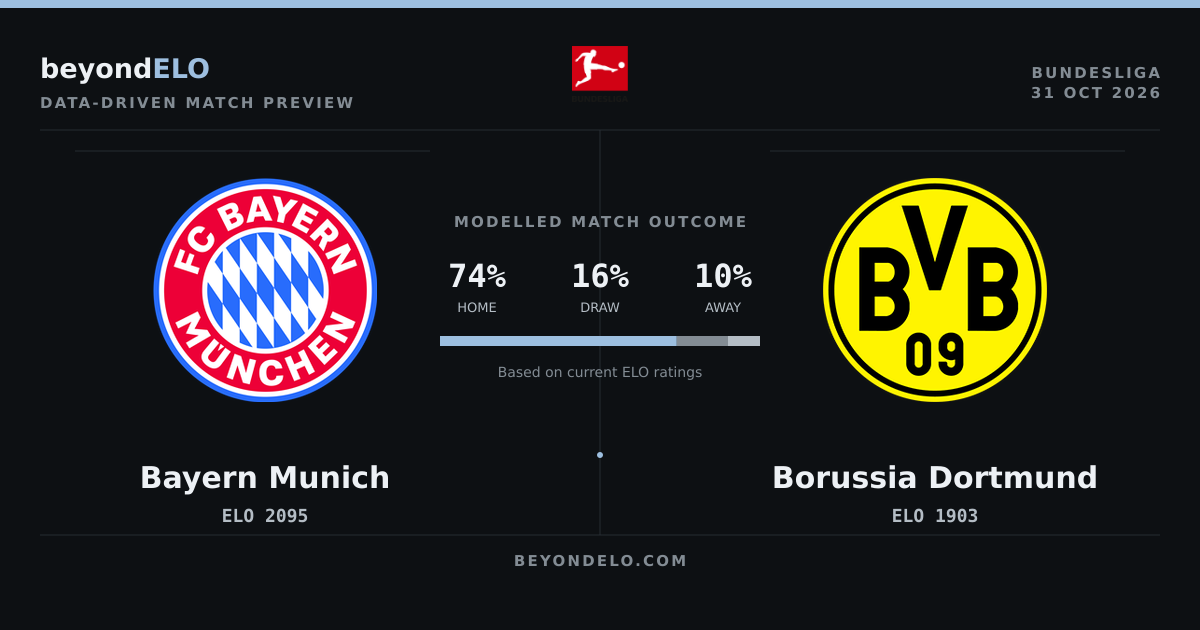
Bayern Munich host Borussia Dortmund on 2026-10-31 separated by 192 ELO rating points. Explore the data-first breakdown of their Bundesliga meeting and ELO movement.
Quick read
- Head-to-head precedent: Bayern won the last encounter 3-2 away from home on 2026-02-28, completing back-to-back regular-season victories over Dortmund.
- The rating gap: A 192-point rating divide places the hosts 2nd and the visitors 13th in the European rankings.
- Recent trajectory: Across their last five recorded fixtures, both clubs generated negative net ELO movements (-16 for the hosts, -23 for the visitors) despite unbeaten runs in their most recent domestic outings.
Match context and rating fundamentals
When Bayern Munich host Borussia Dortmund in the Bundesliga on 2026-10-31, the fixture matches two teams situated in the upper tiers of UEFA football but separated by a substantial rating distance.
beyondELO calculates team strength through an adapted Glicko-2 framework that adjusts club ratings based on match outcomes relative to pre-game expectations. The resulting ratings map directly into a two-way performance expectation via the match predictor.
| Metric | Bayern Munich | Borussia Dortmund |
|---|---|---|
| European Rank | 2 | 13 |
| Current ELO Rating | 2095 | 1903 |
| Season ELO Change | -18 | +1 |
| Two-Way ELO Expectation | 81% | 19% |
| Head-to-Head (Last 3) | 2 wins, 1 draw | 0 wins, 1 draw |
| Last Meeting Result | 3-2 (Away win, 2026-02-28) | 2-3 (Home loss, 2026-02-28) |
The model generates an 81% to 19% two-way performance expectation in favour of the home side. Crucially, this output represents a binary expectation figure rather than a three-way home/draw/away probability distribution; it does not assign an explicit draw probability.
Head-to-head records and recent matches
The supplied head-to-head record shows three Bundesliga fixtures dating back to 2025-04-12. Bayern Munich have remained undefeated across this sequence, drawing 2-2 at home on 2025-04-12 before taking a 2-1 home victory on 2025-10-18 and a 3-2 away win on 2026-02-28. In total across these three games, the home side scored seven goals to Dortmund's five.
Both teams enter the fixture on the back of mixed five-match recorded samples:
| Date | Club | Opponent | Venue | Comp (Stage) | Score | ELO Shift |
|---|---|---|---|---|---|---|
| 2026-10-25 | Bayern Munich | Freiburg | Away | Bundesliga (Regular) | 3-1 | +5 |
| 2026-10-21 | Bayern Munich | Arsenal | Home | UCL (League Phase) | 2-2 | -1 |
| 2026-10-17 | Bayern Munich | RB Leipzig | Home | Bundesliga (Regular) | 6-1 | +4 |
| 2026-10-13 | Bayern Munich | Viking | Away | UCL (League Phase) | 3-3 | -15 |
| 2026-10-10 | Bayern Munich | Augsburg | Away | Bundesliga (Regular) | 2-2 | -9 |
| 2026-10-24 | Borussia Dortmund | Frankfurt | Home | Bundesliga (Regular) | 1-0 | +4 |
| 2026-10-20 | Borussia Dortmund | Sabah | Away | UCL (League Phase) | 2-1 | +8 |
| 2026-10-17 | Borussia Dortmund | Union Berlin | Away | Bundesliga (Regular) | 0-0 | -6 |
| 2026-10-14 | Borussia Dortmund | Bodø/Glimt | Away | UCL (League Phase) | 0-1 | -21 |
| 2026-10-09 | Borussia Dortmund | Bremen | Home | Bundesliga (Regular) | 2-2 | -8 |
Dissecting the rating dynamics
While the higher-rated side holds a net season change of -18, their five-match sample from 2026-10-10 to 2026-10-25 produced a 2-3-0 record with 16 goals scored and 9 conceded. Draw results against lower-rated opponents—specifically 3-3 against Viking (-15 points) and 2-2 against Augsburg (-9 points)—drove their sample net rating down by 16 points, even though domestic wins over RB Leipzig (6-1) and Freiburg (3-1) recovered 9 points.
Conversely, the lower-rated side holds a marginal positive season shift of +1. Their five-match window between 2026-10-09 and 2026-10-24 ended 2-2-1 with 5 goals scored and 4 conceded, yielding a -23 net rating drop. That deficit was heavily influenced by a 0-1 away defeat to Bodø/Glimt (-21 points) and a 2-2 draw with Bremen (-8 points), despite consecutive wins against Sabah and Frankfurt heading into this tie.
Because recent-form samples evaluate only recent database matches and can span multiple seasons, they should not be conflated with the season-wide rating totals.
Evidence-based verdict
The data underlines a decisive rating advantage for the higher-ranked host, supported by back-to-back league head-to-head wins and an 81% two-way expectation. While both teams suffered sharp rating penalties from draws or losses against lower-rated opposition during mid-October, the home team's attacking output (16 goals in five games) contrasts sharply with the visiting side's five goals in the same span. The ELO model, however, does not know tactical adjustments, player availability, or in-match red cards.