Spain vs France: Rating Gaps and Club Depth in 2026/27
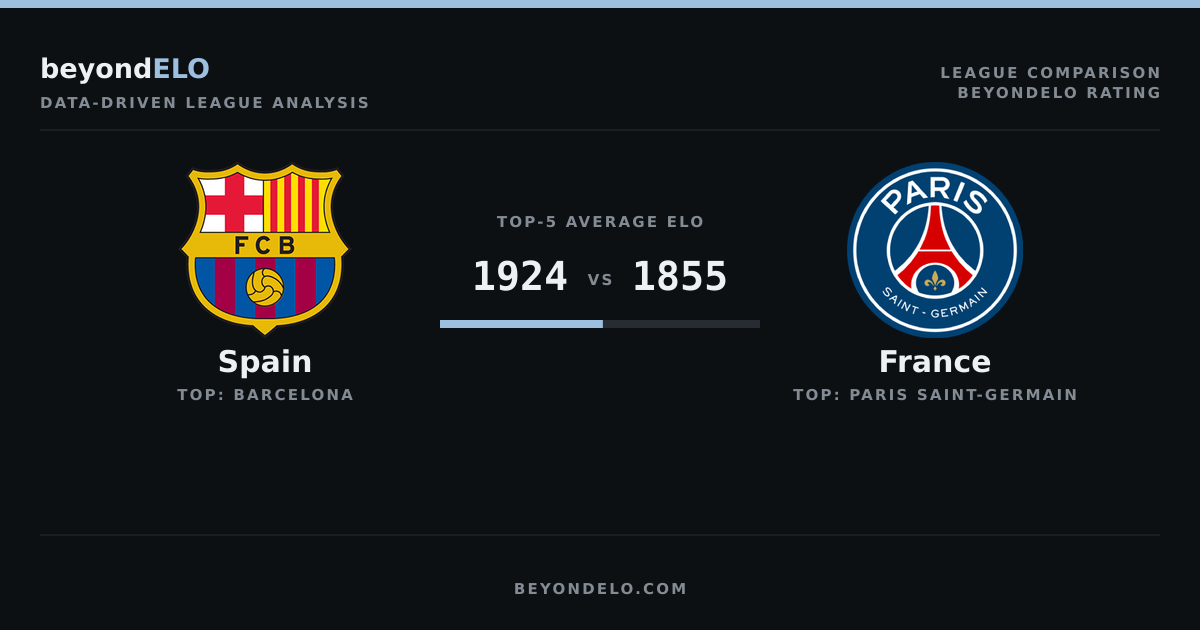
Spain's top five clubs lead France by an average of 69 ELO points in 2026/27. While PSG edge the apex, Spain commands the upper-tier depth.
Assessing relative league strength across European football requires looking beyond single-match results and isolated European runs. By measuring club performance through beyondELO’s Glicko-2 ELO model, we can evaluate structural quality and aggregate competitive standards across borders.
As of 20 October 2026, the 2026/27 season presents a notable gap between two of UEFA's prominent domestic leagues. Spain's top five clubs post an average ELO rating of 1924, compared to France's top five average of 1855. This 69-point difference highlights contrasting profiles: while France fields the highest-rated individual club across both nations, Spain demonstrates an advantage in elite depth and upper-tier density.
The Top-Five ELO Landscape
A direct comparison of the top five ranked clubs in the Spain rankings and the France rankings demonstrates how the aggregate scores diverge.
| Country | Club | European Rank | ELO Rating | Season ELO Change |
|---|---|---|---|---|
| Spain | Barcelona | 4 | 2065 | +67 |
| Spain | Real Madrid | 6 | 2012 | +32 |
| Spain | Atletico Madrid | 15 | 1908 | +52 |
| Spain | Real Betis | 23 | 1856 | +70 |
| Spain | Villarreal | 46 | 1777 | -6 |
| France | Paris Saint-Germain | 3 | 2082 | +3 |
| France | Monaco | 34 | 1823 | +29 |
| France | Lyon | 38 | 1812 | +10 |
| France | Lens | 43 | 1793 | -30 |
| France | Lille | 49 | 1765 | -19 |
Spain’s mean rating of 1924 places its leading bracket firmly in the upper echelon of continental competition, whereas France’s average of 1855 is weighed down by a sharp internal decline beyond its front-runner.
The Apex: PSG Out in Front, but Spain Has Multiple Heavyweights
The highest-rated team in this comparison belongs to France. Paris Saint-Germain occupy 3rd place in the European rankings with an ELO of 2082, 17 points ahead of Barcelona (2065, rank 4) and 70 points ahead of Real Madrid (2012, rank 6).
However, Paris Saint-Germain stand alone in French football as an elite force above the 2000-point threshold. Spain, conversely, possesses two clubs clearing the 2000-point benchmark. The gap between Spain's two leading clubs is just 53 rating points, representing a balanced elite tier at the summit of La Liga. In contrast, PSG sit 259 rating points clear of France’s second-highest club, Monaco. While French football claims the singular peak of the comparison, Spanish football provides two clubs positioned inside UEFA's top six.
The Second-Tier Cliff: Structural Depth Compared
The 69-point gap between the two countries' top-five averages is largely established between the second and fourth seeds.
Spain’s third-ranked side, Atletico Madrid, hold an ELO of 1908 and a European rank of 15. That is 85 points higher than Monaco (1823, rank 34), who occupy France’s second position. In fact, Spain's fourth-ranked club, Real Betis (1856, rank 23), also outrates France’s second-best side by 33 points.
France displays a compact sub-cluster between rank 34 and rank 49:
- Monaco: 1823 (rank 34)
- Lyon: 1812 (rank 38)
- Lens: 1793 (rank 43)
- Lille: 1765 (rank 49)
This group of four clubs is separated by just 58 points. While this indicates competitive balance within Ligue 1's chasing pack, it occurs at a lower tier of European hierarchy. France possesses zero clubs ranked between 4th and 33rd across UEFA competitions. Spain fills that vacuum with three sides: Real Madrid (6th), Atletico Madrid (15th), and Real Betis (23rd).
Only when reaching the fifth position do the two leagues converge in rating. Spain's Villarreal sit on 1777 (rank 46), just 12 points above France's fifth-ranked Lille on 1765 (rank 49). At the threshold of the European top 50, both nations feature comparable baselines, but Spain's pathway to that baseline is far broader.
Early 2026/27 Momentum Trends
The season rating changes provide insight into early 2026/27 trajectory. Across their five clubs, Spanish sides have generated a net increase of +215 rating points. France’s top five clubs, by contrast, have combined for a net drop of -7 points.
Spain’s momentum is driven by substantial gains across its top four teams. Real Betis lead all clubs in the sample with a +70 rating increase, followed closely by Barcelona (+67), Atletico Madrid (+52), and Real Madrid (+32). Villarreal are the only Spanish club among the five to lose ground, falling by 6 points.
In France, upward movement has been more subdued. Monaco have added 29 points, Lyon have gained 10, and Paris Saint-Germain have remained broadly level with a +3 shift. These gains are wiped out by declines further down the order, with Lens falling by 30 points and Lille by 19 points.
Rating Distribution Takeaways
The beyondELO data highlights distinct structural realities for both nations heading into the remainder of the 2026/27 campaign:
- Pinnacle vs Breadth: Paris Saint-Germain give France the highest individual peak at 2082, but Spain's pairing of Barcelona (2065) and Real Madrid (2012) delivers greater top-end presence.
- The Upper-Middle Class: Spain’s mid-tier strength creates the top-five separation. Real Betis and Atletico Madrid bridge the gap between title contenders and mid-table sides, whereas France experiences an immediate 259-point drop after PSG.
- Baseline Parity: At the tail end of the European top 50, the baseline converges. Villarreal (1777) and Lille (1765) demonstrate that outside the European qualification tiers, both leagues produce similar mid-table baselines.
Spain’s 1924 average confirms greater squad strength across multiple continental competitors, whereas France’s 1855 average reflects a top-heavy structure anchored by a solitary European heavyweight.